SHARE


 Somalia
21-09-2026 | di COOPI
Somalia. Emergency cash assistance helps Faduma boost her small business
In Dinsoor District, in Somalia, families continue to face the effects of drought, reduced livelihood opportunities and rising prices of food and other basic commodities. Although local markets remain functional, many vulnerable households struggle to afford what they need because of limited income and reduced purchasing power. For families depending on small businesses and daily income, meeting immediate household needs can often mean using the same limited resources they depend on to earn a living.
Faduma Abdulle Mohamed lives in Buula Geeley Village in Dinsoor District with her family of six. Faduma and her family moved from Tugaarhoosle to here (in Buula Geeley Village) seeking refuge from the drought and conflict induced displacement to a safer place to settle. Starting again in a new location was not easy. With a family to provide for and few income opportunities available to her, one of her first concerns was finding a simple way to earn enough to contribute to the household’s daily needs.
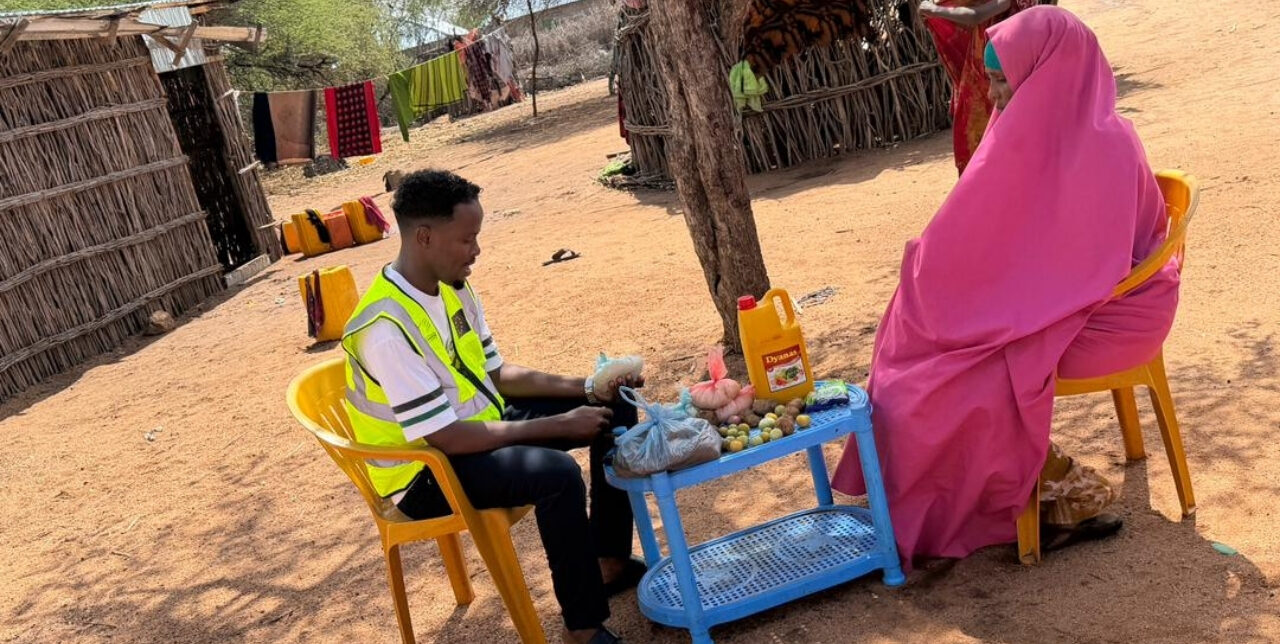
She needed something she could start with limited resources and manage while taking care of her family. Selling vegetables from a small vegetable table became a practical option. It did not require her to establish a large business, and she could buy small quantities of vegetables, sell them within the community, and use what she earned to support her household.
However, the small income from the vegetable table was often not enough to meet the family’s daily needs and at the same time maintain enough money to restock the business.
She says
When we came to live here, I had to think about how I could help my family because we needed a way to earn something for our daily needs. My husband found daily labor work in town, but the long commute made it difficult, and the work was not always consistent. I decided to start selling vegetables because it was something small that I could manage with the little money I had. But it was difficult. Most of the money I earned was used for food and other needs at home. When my family needed food, I had to use whatever money I had, even when I had planned to buy more vegetables. Sometimes I would have very little left to sell the next day.
The situation faced by Faduma was common among vulnerable households in Dinsoor. The initial assessment conducted in the district found that families were facing severe food insecurity and increasingly relying on measures such as reducing meals and borrowing to cope with their daily needs. While markets remained accessible and commodities were available, high prices combined with low household income meant that affordability remained a major challenge for vulnerable families.
To respond to these needs, Faduma was selected from 600 vulnerable households to receive Multipurpose Cash Assistance implemented by COOPI through the Somali Cash Consortium (SCC), with financial contributions from European Civil Protection and Humanitarian Aid Operations (ECHO) and the Swiss Agency for Development and Cooperation (SDC). The assistance gave families the flexibility to prioritize their most urgent needs according to their individual circumstances. The beneficiaries received USD 100 per month for three consecutive months.
Receiving USD 100 every month for three months helped my family a lot. I used the first cash transfer mainly to buy food and meet other important needs at home. With the second transfer, I was able to restock my vegetable table so that I could continue selling and have a more consistent source of income. When I received the third transfer, I bought some essential household items and saved the remaining amount for future needs. The cash assistance gave me the flexibility to meet my family’s immediate needs while also keeping my vegetable business going,
Faduma explains.
For Faduma, the importance of the assistance went beyond the three months in which she received the cash. The vegetable table had started as a simple way for her to earn something after settling in the village, but it had become an important source of support for her household. By reducing some of the pressure on her limited income, the cash assistance helped her keep that source of income going.
The cash assistance has ended, but I still have my vegetable table, and I want to continue working. I started it because I needed a way to support my family, and even though it is small, it helps us. Now I try to keep some of the money I earn so that I can sustain my income and continue selling the vegetables. My hope is to increase my stock little by little to grow the business and continue providing for my family. I am very grateful to COOPI, SCC and the donor for supporting us at a time when we really needed the assistance.
Faduma’s story shows how timely cash assistance can help a family that is trying to rebuild its life and establish a source of income after moving to a new community. For Faduma, the three-monthly cash transfers helped meet her family’s immediate needs while allowing her to protect the small vegetable business she had started as a way of supporting them. What began as a simple income option has become something she hopes to maintain and gradually strengthen as she works towards a more stable future for her family.